Youth Experiences with Active Transportation in Yellowknife, Northwest Territories, Canada

About the Prioritizing Populations Study Group
My name is Alexandra Sbrocchi, and I am a rural planner and third-year PhD candidate in the School of Earth, Environment and Society at McMaster University, working under the supervision of Dr. Léa Ravensbergen. I am part of Mobilizing Justice’s Theme 1 Working Group, Prioritizing Populations (Case Studies), led by Dr. Léa Ravensbergen and Dr. Jérémy Gelb.
This working group prioritizes the needs and aspirations of people who have historically been underserved by transportation systems. Each case study focuses on a particular transportation mode (such as public transit or active transportation), a specific population (such as youth or autistic young adults), and a Canadian geography such as Northern Canada, the Prairies, Ontario or British Columbia. In addition to our individual case studies, the working group is also collaborating on a project that reflects on lessons learned from conducting community-based and qualitative transportation research, with plans to publish our findings in 2026.
About my case study and PhD research
My case study and ongoing PhD research, Exploring Active Transportation Amongst Youth in Yellowknife, Northwest Territories, Canada, is currently in the data collection phase. While the benefits of active transportation are widely recognized and well documented,, there is a notable gap in research focused on northern Canadian contexts. Furthermore, transportation research that incorporates youth perspectives tends to do so indirectly, engaging with parents/guardians on behalf of youth. This project seeks to address these gaps by directly collaborating with youth in Yellowknife. By centering their firsthand accounts, the research moves away from “speaking for” youth and instead creates space for their lived experiences and perspectives on active transportation in their community. Findings from this direct engagement are expected to inform aspects of the City of Yellowknife’s ongoing transportation plan, Let’s Move YK!
“It is important to note that youth is a fluid concept with no universally set age range. For the purposes of this work, youth has been defined as those aged 12-20. This age range captures the transition from dependent to more independent mobility and aligns with age thresholds embedded in Canadian transport policies and regulations, such as minimum driving ages, public transit fare discounts, and helmet laws.”
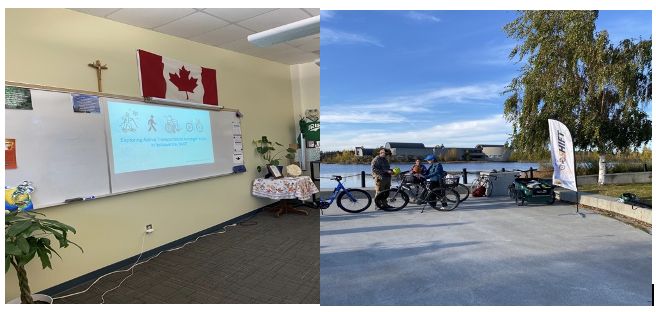
Since 2023, I have traveled to Yellowknife for extended stays and will continue to do so throughout the project. These visits have focused on relationship-building and data collection using community-based methods. Data collection includes a survey inspired by the 2021 Canadian National Active Transportation Survey, adapted to incorporate northern- and youth-specific questions, as well as interviews and photovoice component.
During these visits, I have received valuable guidance and support from local residents, presented the project to students in grades 8 through 12, met with the consultants developing Let’s Move YK! , discussed the project with the mayor, and connected with the creator of SHIFT, a Yellowknife-based initiative that encourages residents to adopt cycling for daily commutes.
Preliminary Key Findings
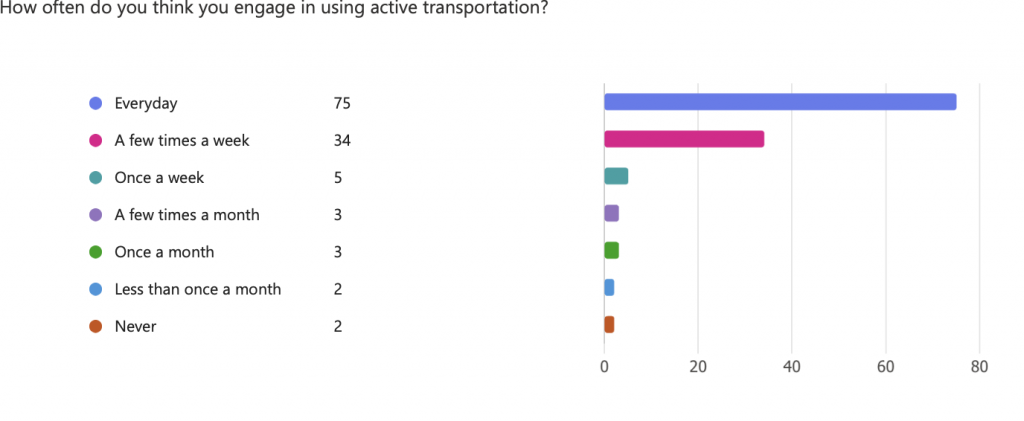
The survey components of the study opened in late September 2025 and closed at the end of October 2025. Over 120 youth fully completed the survey, and analysis of the results is currently underway. While findings are preliminary, several early patterns are emerging:
- Over two-third of respondents indicated that engaging in active transportation in Yellowknife is something that can be done all year, provided certain structural and environmental conditions are met. These include reliable municipal snow clearing, access to weather-appropriate attire, and reasonable commute lengths (i.e., within 15-minutes).
- More than half of survey respondents reported using some form of active transportation daily to travel to school, a friend’s house, or to partake in a leisure trip.
- The majority of responses suggest that youth do not often engage in active transportation alone and typically accompanied by a parent/ guardian, or a friend(s).
Looking ahead
Data collection for the interview and photovoice components is ongoing and is expected to be completed by mid-2026. Overall, this study aims to establish a framework for directly collaborating with youth in transportation research through community-based methodologies. By centering youth perspectives, the project seeks to generate an authentic understanding of active transportation in a Northern Canadian community and to demonstrate how the lived experiences of youth people can meaningfully inform transportation planning and policy development.
You may also like
 Removing Fare Barriers: Free Public Transit for Youth Experiencing Homelessness in Toronto
Noah Kelly is the Director of Research & Partnerships at the Transit Access Project (TAP) and has recently completed his Master of Arts at McGill… Read More
 The Hidden Price of Clean Transportation
Lessons from the Transition to Electric School Buses The French version of this blog post is available HERE. Canada’s 51,000 school buses… Read More
 Documenting Canada’s Community Response to Transport Poverty: A 5-Year Review
With the recent release of the Canadian Community Initiatives Addressing Transport Poverty Catalogue, accompanying report, and interactive web map, a multi-year effort… Read More