Updated Catalogue Documents Continued Growth in Community Response to Transport Poverty
Transportation policy and infrastructure decisions affect everyone in Canada, no matter what part of the country you live in or how you get around. As a result, high-profile transportation announcements are often made at election time, whether it be a promise of free transit in Nova Scotia, new rail lines and upgraded highways in BC, or a traffic tunnel under Highway 401 and legislation to curtail municipalities’ ability to build new bike lanes in Ontario. Proposed plans that seem ill-considered or misguided can be an impetus for community members to get together to organize around a different vision. Currently, there are at least 335 community initiatives in Canada working to advance transport equity in some way.
The Canadian Community Initiatives Addressing Transport Poverty Catalogue is a collaborative project between the Mobilizing Justice Theme 2 Transportation Modes team and The Centre for Active Transportation (TCAT). First released in 2021, this annually updated catalogue compiles community initiatives across Canada focused on addressing transport poverty and increasing modal choices. The most recent version of the catalogue, accompanying report and web map, produced by graduate student Christine Yanagawa, was released earlier this month. With this 2024 update, there are now 335 active community initiatives in the catalogue. A new archive database was also created to document discontinued or completed initiatives.
A couple of new features of interest in the catalogue this year:
- Following recommendations from Mobilizing Justice’s Community and Equity Advisory Table, we added three new attributes to provide more information about the host organizations, to explore how low income is defined, and to understand the extent to which intersectionality is considered.
- We also made a deliberate effort to find more initiatives that support driving and public transit. In particular, we looked for community-based transportation services for older adults since “[d]espite filling important gaps in the transportation system, these services are often overlooked in transportation research and planning.”
Close to 50 initiatives were added. A diverse sampling are highlighted below, all well-established programs but new to the catalogue:
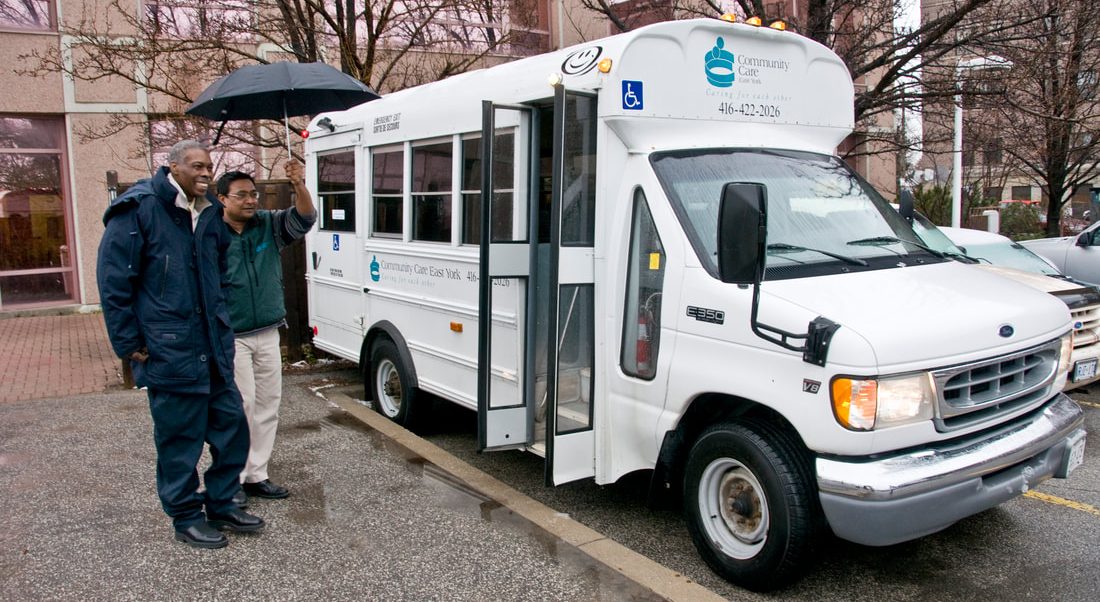
- Toronto Ride, a collaborative partnership of 13 not-for-profit, community support agencies, provides assisted door-to-door transportation to seniors 55+ and adults with disabilities who are not eligible for Wheel-Trans.
- The WRENCH, a Winnipeg-based community bike shop and registered charity that refurbishes bicycles and bike parts to divert waste from landfills and provides bike programming for youth.
- Horse Council BC, a membership-driven not-for-profit association that offers road safety training, advocacy and equipment for horse riders in rural and remote communities.
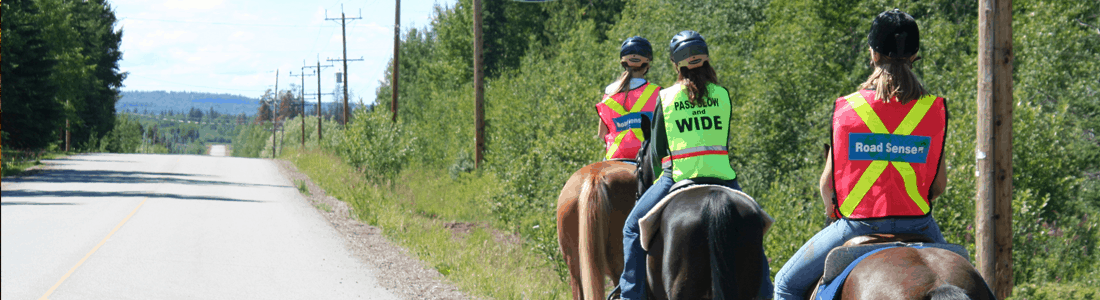
New to this scan are three community initiatives focused on improving accessibility for populations engaging in equine-driven transportation (i.e., horse-riding, carriage riding). Photo Credit: Horse Council British Columbia
Analysis of the 335 initiatives revealed the following key takeaways:
- The majority of transport poverty initiatives are in the formalized non-profit sector. While over half of the initiatives focus specifically on transport poverty, the majority of these are based within more formalized or corporate non-profit and charitable organizations.
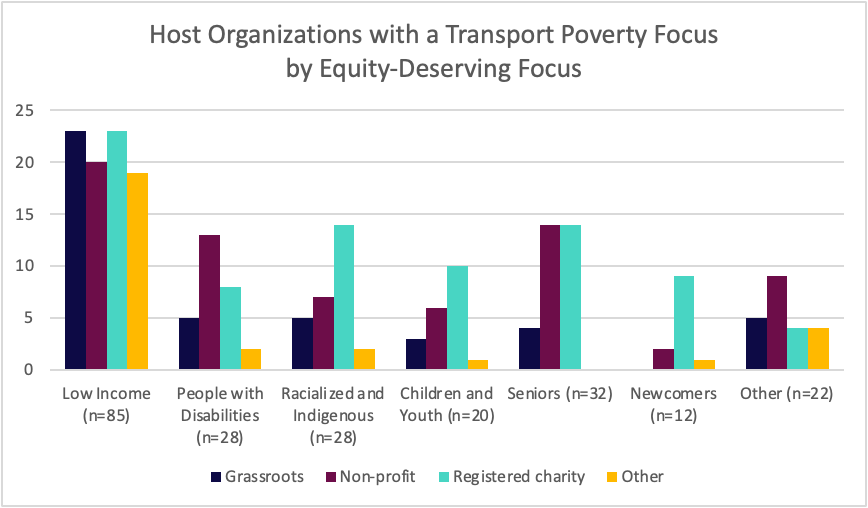
- The most common equity-deserving population focus is people with low income. For the initiatives with a focus on transport poverty, while we found the equity-deserving groups that are prioritized to be wide-ranging, the most prevalent equity-deserving population focus is people experiencing low income.
- Most initiatives do not use the term ‘intersectionality’ or define ‘low income’. Community initiatives that support people experiencing low income lack a standardized definition. Also, community initiatives rarely explicitly incorporate the terminology of “intersectionality” in their mandates. These findings indicate that while many community initiatives address transport inequities related to low income and intersectionality, defining terminology or frameworks may be less central to their work.
This catalogue continues to provide a foundation for understanding Canadian community initiatives working to address transport poverty and increase transportation options beyond the private automobile. We hope it will be useful for advocates and practitioners alike to better understand the transportation barriers and adaptive practices being implemented across Canada and ultimately inform the development of evidence-based policy recommendations to advance transport equity.
Nancy Smith Lea is the Community Co-Lead of the Mobilizing Justice Transportation Modes Thematic Working Group and a Senior Advisor at The Centre for Active Transportation (TCAT) at Clean Air Partnership.
You may also like
 Making it safe, Making it work, and Making it fun: strategies for cycling with young children in Hamilton, Canada
Getting around by bike with young children is not always easy. Children are heavy, family schedules can be busy, and children often need to be… Read More
 What can we learn from a Bike Bus program in rural Nova Scotia?
There’s a revolution happening in the rural community of Hebbville, Nova Scotia (Mi’kma’ki) and it’s accompanied by a healthy dose of bike joy. Since 2020,… Read More
 Removing Fare Barriers: Free Public Transit for Youth Experiencing Homelessness in Toronto
Noah Kelly is the Director of Research & Partnerships at the Transit Access Project (TAP) and has recently completed his Master of Arts at McGill… Read More