Making it safe, Making it work, and Making it fun: strategies for cycling with young children in Hamilton, Canada
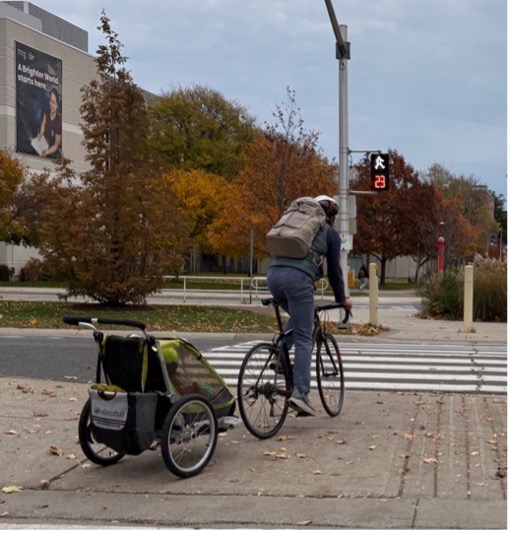
Getting around by bike with young children is not always easy. Children are heavy, family schedules can be busy, and children often need to be transported to a variety of destinations across the city. As a result, cycling is not always the most convenient or accessible way for families to get around, particularly in cities that have been designed to prioritize car travel.
However, despite the difficulties, many parents continue to cycle with their children. We set out to better understand their experiences and to unpack the steps parents take to make cycling a feasible transport option for their families.
Key Findings
Semi-structured interviews were conducted with 14 parents who regularly cycle with their young children in Hamilton, Ontario, Canada. We found that parents employ a variety of strategies aimed at making cycling a more positive experience. These strategies are grouped below into three themes: Making it safe, Making it work, and Making it fun.
Theme 1: Making it safe
To make it safe, parents cycled specific routes, modified their behaviours, and avoided cycling in inclement weather. Parents discussed overwhelmingly preferring to cycle on protected infrastructure or quiet, residential streets with their children. To stay on protected infrastructure or to avoid areas that felt unsafe, parents often took less direct routes even if it meant cycling up large hills or taking routes that added significant distance. As one parent, Angela, mentioned: “There are stretches where the infrastructure’s really good, but then when you’re missing a chunk of the route it kind of like, ruins the whole thing, because then I can’t do this 500-meter stretch and I make like a 15-minute detour to avoid it.”
Parents equally advocated for their safety by modifying their cycling behaviours. For example, several parents discussed how they cycled in the middle of the lane to prevent cars from passing and felt they were more likely to use a bell or call out drivers when with their children. Other parents discussed how they reduced their cycling speeds when with their children, prioritizing safety over quickly reaching a destination.
Hamilton has cold, snowy winters that strongly influenced parents cycling patterns. In the interest of safety, only a few participants continued to cycle in rainy or snowy conditions to avoid falling or their children catching a cold. Parents also avoided cycling in the dark with their children, especially on residential streets that lacked proper lighting. When parents did cycle in the winter or in the dark, they emphasized using equipment such as bikes with thicker tires, cargo bike rain covers, and bike lights.
Theme 2: Making it work
To make cycling with their children “work”, parents planned their trips, used specific equipment, and put care into selecting and creating secure bicycle parking. While cycling with children was often described as a convenient form of transportation, parents noted that it involved additional logistical considerations. To navigate these considerations, parents planned out destinations in advance, packed extra clothing when necessary, and created distance thresholds for how far they were comfortable cycling with their children.
Parents used specific equipment to facilitate cycling with their children, particularly electric bicycles and cargo bikes. Electric bicycles allowed parents to go further while using less energy and cargo bikes enabled parents to transport multiple children and/or other household items. Electric cargo bikes boasted both these benefits and were highly appreciated by parents who used them. As highlighted by Simone: “I got this amazing electric cargo bike and it’s a game changer, I can fit all three [of my children] plus backpacks and even grocery bags.” Some parents also discussed a desire to invest in other equipment such as studded tires for snow travel or rain covers to keep children warm and happy while cycling.
Parents placed emphasis on the importance of secure and accessible bicycle parking, both at destinations and at home. Parents felt limited to cycling to destinations they knew had secure bicycle parking and felt heightened concern about bicycle theft in areas that felt unfamiliar or unsafe. Parents equally reported modifying their at-home bicycle storage setups to make trips more accessible and to reduce theft risk. Strategies included building sheds that accommodated large cargo bikes, adding additional locking mechanisms, and bringing valuable e-bike batteries inside overnight.
Theme 3: Making it fun
Cycling with children was unanimously discussed as an inherently enjoyable mode of transportation for both parents and children. Parents described how cycling allowed them to bond with their children and felt that it granted children a unique opportunity to express themselves and connect with their surroundings. As Miguel put it: “My son enjoys the freedom to look around, to breathe the natural air… and enjoy the nature and stuff like that”.
Parents felt that bicycle design and the speed of bicycle travel allowed them to converse with their children and involved them in their journeys. As Mark described: “[My kids] definitely feel more connected than just throwing them in the back of the car and driving home. I think I have heard my oldest kind of talk about it as if he feels, like, more involved in his route, you know?”
Parents built upon this joy by incorporating exciting destinations and opportunities for play into their cycling trips. For example, Phil shared: “We’re more likely to do a bit of a detour with the kids and stop somewhere that is more fun for them like a break or to get a little treat or just see something a bit more interesting than making a direct route.”
Future steps
This research identifies some of the individual-level strategies that parents use to sustain cycling with young children in an auto-centric Canadian city. These strategies are employed by parents to navigate cities that are not designed for them, both as cyclists and as parents. However, in an ideal scenario, these strategies do not need to exist. With continued infrastructure development, research, education programs, government support, and city design that is geared towards the needs of families, cycling can hopefully become a mode of transportation that is inherently safe, feasible, and enjoyable for parents and children alike.
You may also like
 What can we learn from a Bike Bus program in rural Nova Scotia?
There’s a revolution happening in the rural community of Hebbville, Nova Scotia (Mi’kma’ki) and it’s accompanied by a healthy dose of bike joy. Since 2020,… Read More
 Removing Fare Barriers: Free Public Transit for Youth Experiencing Homelessness in Toronto
Noah Kelly is the Director of Research & Partnerships at the Transit Access Project (TAP) and has recently completed his Master of Arts at McGill… Read More
 The Hidden Price of Clean Transportation
Lessons from the Transition to Electric School Buses The French version of this blog post is available HERE. Canada’s 51,000 school buses… Read More