Comparing my experience cycling in Vancouver and Montréal
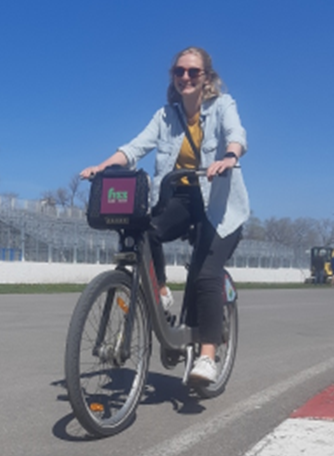
Kate Hosford, PhD Candidate at Simon Fraser University, spent the month of May in Montréal working with Dr. Lise Gauvin at the University of Montréal. In this post, she compares her experience cycling in Vancouver and Montréal.
Vancouver and Montréal made headlines in 2019 for ranking in the top 20 most bicycle-friendly cities in the world according to the Copenhaganize Index. In fact, the two cities tied for 18th place.
I’ve been a consistent commuter cyclist in Vancouver for the past four years, and recently had the opportunity to spend a month in Montréal, where I mainly got around by bike. While in Montréal, I spent a lot of time comparing my experience as a cyclist in Montréal to Vancouver.
Learning that the two cities had recently tied in their bicycle-friendliness, I felt compelled to write this blog to declare the winner (from my perspective as an ‘Enthused and Confident’ cyclist).
To cut to the chase – both cities have many things going for them -– but Montréal is hands down a more bicycle friendly city than Vancouver.
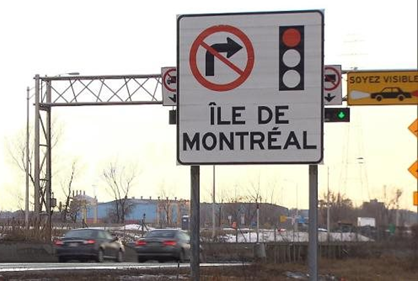
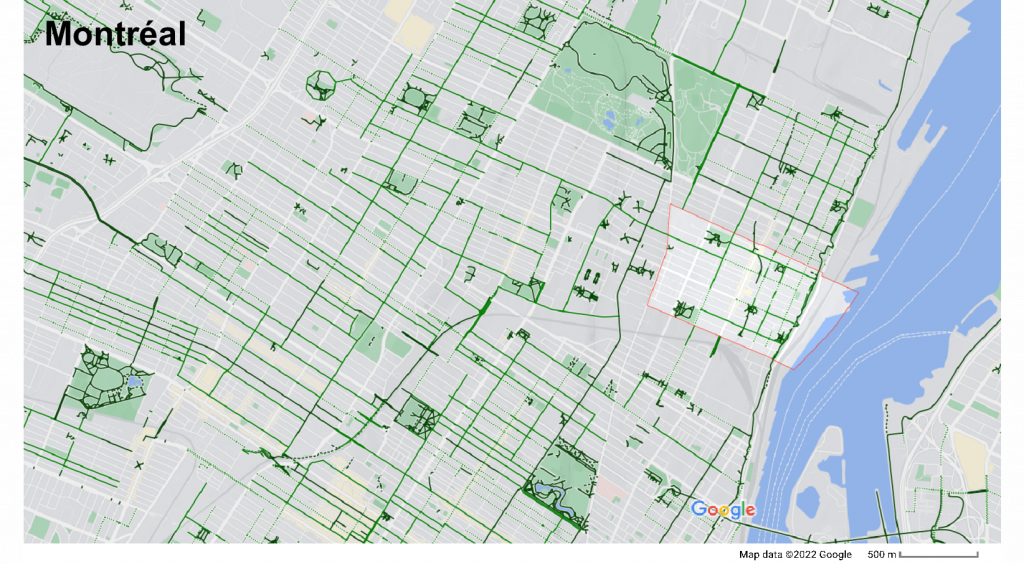
Montréal has a well-connected cycling network that is easy to navigate and street and intersection design features that made cycling feel safe – such as one-way streets, no right turn on red lights, and advanced pedestrian and cyclist crossings at many intersections.
On top of that, I admired Montréal’s cycling culture. I felt that cyclists were more relaxed and respectful of other cyclists than in Vancouver (for example, there was a lot less lycra and rush to get places). I also must admit, I did enjoy not having to wear a helmet while cycling in Montréal.
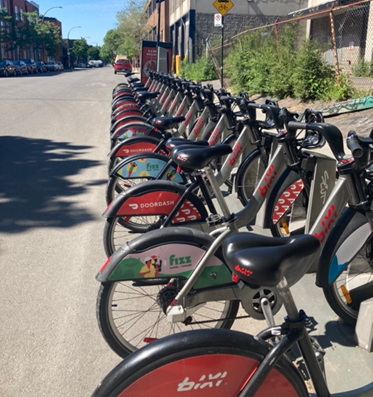
The number of children cycling – which is a good indicator of the safety and comfort of a cycling network – seemed about the same between Montreal and Vancouver. However, in both cities, I was based in neighbourhoods that have relative few families with children. The BIXI bike share system was the main way I got around. BIXI Montréal was so affordable ($18/month for unlimited 45-minute trips) and accessible (750+ stations throughout the city) that it was often the obvious transportation choice. The bike share system is also well used by both locals and tourists alike.
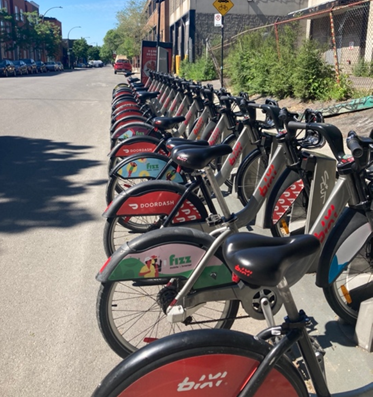
For the past couple of weeks, BIXI Montréal has averaged between 40,000 to 50,000 trips per day. In contrast, Vancouver’s bike share system, Mobi by Shaw Go, only averaged between 2,000 to 4,000 trips per day.
The one aspect where Vancouver beats Montréal is the quality of bicycle infrastructure and streets. Much of the paint on the asphalt for Montréal’s cycling infrastructure was wearing away. And after experiencing Montréal’s incredibly bumpy and poorly maintained roads, I have a newfound appreciation for Vancouver’s streets. Besides this aspect – Montréal is the clear frontrunner for me when it comes to bicycle friendliness.
You may also like
 Making it safe, Making it work, and Making it fun: strategies for cycling with young children in Hamilton, Canada
Getting around by bike with young children is not always easy. Children are heavy, family schedules can be busy, and children often need to be… Read More
 What can we learn from a Bike Bus program in rural Nova Scotia?
There’s a revolution happening in the rural community of Hebbville, Nova Scotia (Mi’kma’ki) and it’s accompanied by a healthy dose of bike joy. Since 2020,… Read More
 Removing Fare Barriers: Free Public Transit for Youth Experiencing Homelessness in Toronto
Noah Kelly is the Director of Research & Partnerships at the Transit Access Project (TAP) and has recently completed his Master of Arts at McGill… Read More