Advancing transportation equity: a practical guide for Canadian practitioners
Across Canada, governments are investing in major transportation infrastructure and making policy decisions that will shape how people and goods move for decades to come. These choices impact our public transit, roads, bridges, cycling networks, and other forms of transportation, influencing not only how these systems are built and operate but also who can access the opportunities and essential services they provide. Ensuring that these investments benefit everyone, however, requires more than building and improving transportation infrastructure. It requires understanding how transportation systems affect different communities and addressing the barriers that prevent some people from fully benefiting from them. How can practitioners identify existing barriers, understand who benefits from a project, and make decisions that lead to more equitable outcomes?
To help answer these questions, Mobilizing Justice, in collaboration with Urban Strategies and HDR, developed a guide for practitioners who aim to advance equity in transportation. Drawing on the experiences of transportation professionals across Canada, the guide offers practical considerations, tools, and examples to help practitioners integrate equity into transportation planning and project delivery.
Transportation shapes access and quality of life.
Transportation equity concerns the fair distribution of transportation benefits and burdens, recognizing diverse needs and experiences, ensuring meaningful participation in decision-making, and addressing historical and structural injustices to create more just mobility systems. Transport decisions affect the day-to-day lives of real people, from whether an older adult can afford to visit a friend in the next town to the air quality at a children’s playground. Because planning decisions rely on historical patterns, data, and assumptions that can carry bias, planners and decision-makers must ask who benefits, where barriers remain, and how outcomes change over time. The question is not only where we can build and what it will cost, but whose opportunity, health, inclusion, and quality of life will be affected by the decisions we make today.
Traditional planning approaches tend to focus on efficiency, capacity, and cost. However, even relatively small project decisions can create disproportionate effects, improving access for some people while reinforcing barriers for others.
These barriers can take many forms: services that do not operate when people need them, routes that do not connect to essential destinations, fares or vehicle costs that are unaffordable, infrastructure that is physically inaccessible, safety concerns that limit travel, and planning processes that exclude the people most affected by a decision.
The practical case for advancing equity
Taking the time to understand different experiences and to address barriers early can save money and lead to better project outcomes. It can reduce community resistance, limit costly redesign and rework, and lower the risk that infrastructure will need to be retrofitted later.
At a broader scale, more equitable transportation can help people participate more fully in work, education, healthcare and community life. It can improve economic productivity and may reduce pressure on social assistance and health systems.
When limited transportation access compounds existing socioeconomic disadvantage, it can contribute to transport-related social exclusion, making it increasingly difficult for people to participate in everyday activities and increasing the risk of isolation.
Practitioners may struggle to take action because they do not know where to begin or fear making mistakes. To help practitioners design projects that deliver benefits more fairly, the guide offers practical actions and considerations to help users get started without having to develop an approach from scratch.
A resource built by practitioners, for practitioners
The guide grew from shared observations among practitioners who work with Mobilizing Justice and are similarly focused on equity and on identifying common barriers in their work. Those early conversations led the group to consult additional transportation practitioners, confirm the support needed, and explore whether a practical guide could help. Mobilizing Justice and its collaborators joined forces to develop the idea further.
More than 25 municipalities, agencies, consultants, advocacy organizations, and transportation practitioners contributed to the guide, including major cities in Canada from Vancouver to Halifax. Input was gathered through workshops, review rounds, and collaborative discussions from coast to coast.
The process began by asking practitioners what they actually needed rather than developing guidance in isolation. Practitioners shared real-world examples and challenges, which we brought together with our own professional experience and observations. The result is a resource grounded in real-world transportation planning and delivery experience.
What it’s not
This guide is not intended to be a checklist or an academic report, nor does it prescribe a single approach to advancing transportation equity. Instead, it is filled with practical tools designed to help organizations move from good intentions to informed action and provides a common language and framework for discussing transportation equity.
Readers are encouraged to draw on additional resources to promote equity in transportation planning and practice. The content and examples in the guide provide a Canadian focus but may be useful to practitioners in other contexts in designing and delivering equitable transportation projects.
How to use the guide
This guide is designed so readers can jump directly to the sections most relevant to their needs. Each section can be used as a standalone resource for addressing equity challenges in transportation planning, design, and delivery.
Section 1: Explains why equity matters in transportation planning, decision-making, and project delivery.
If you are developing a transportation plan, policy, or investment strategy and want to understand why and how equity should inform transportation decisions, start with this section.
Section 2: Highlights common barriers to equitable outcomes and includes a case study with practical solutions.
If you are managing or delivering a transportation project and facing challenges in translating equity objectives into practice, consult this section for common barriers and practical approaches to addressing them.
Section 3: Provides key equity considerations across every stage of the transportation project lifecycle.
If you are planning, designing, or implementing a transportation project and want to incorporate equity considerations at different stages of its development, go to this section.
Section 4: Offers recommendations and examples for creating inclusive, accessible, and equitable engagement processes.
If you are preparing a public consultation or community engagement strategy and want to ensure that diverse communities can meaningfully participate in decision-making, explore this section.
Section 5: Introduces metrics and indicators for measuring progress toward equity goals and evaluating project outcomes.
If you are conducting an equity analysis, identifying underserved communities, or assessing the distribution of transportation benefits and impacts, explore this section for relevant metrics, indicators, tools, and data sources to support your work.
Finally, if you are new to transportation equity or need clarification on key concepts and terminology, start with Section 1 and consult the Glossary as needed. All sections of the guide provide a practical framework for integrating equity into transportation projects from planning through implementation and evaluation.
Conclusion and call to action
Advancing equity is not an add-on to transportation planning; it is a better way to plan. It helps practitioners make more informed decisions, create broader benefits and deliver more effective outcomes.
Download Advancing Equity in Transportation: A Practitioner’s Guide, explore the sections most relevant to your work, and share it within your organization. We would like to hear how it is working for you, what you are learning and how we can continue to help. To share your thoughts or get in touch with the Mobilizing Justice team, contact us at mj.utsc@utoronto.ca.
You may also like
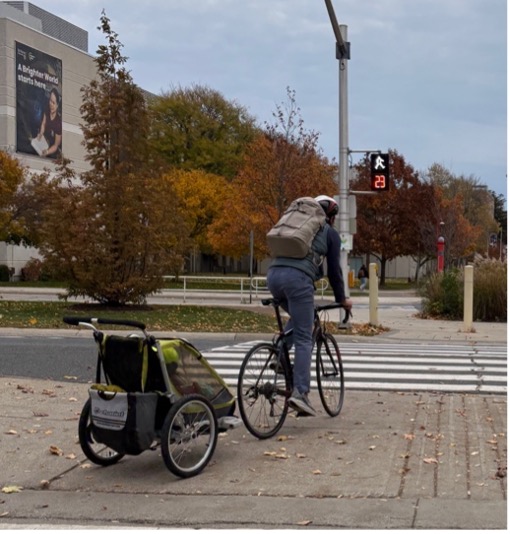 Making it safe, Making it work, and Making it fun: strategies for cycling with young children in Hamilton, Canada
Getting around by bike with young children is not always easy. Children are heavy, family schedules can be busy, and children often need to be… Read More
 What can we learn from a Bike Bus program in rural Nova Scotia?
There’s a revolution happening in the rural community of Hebbville, Nova Scotia (Mi’kma’ki) and it’s accompanied by a healthy dose of bike joy. Since 2020,… Read More
 Removing Fare Barriers: Free Public Transit for Youth Experiencing Homelessness in Toronto
Noah Kelly is the Director of Research & Partnerships at the Transit Access Project (TAP) and has recently completed his Master of Arts at McGill… Read More